

Short answer: a company of 30 to 150 people has three ways to buy operations leadership, and they are not interchangeable. A full-time COO in Latvia costs EUR 9,846 a month in employer cost, EUR 118,147 a year, and does not start for months. A fractional COO costs from EUR 1,800 a month, starts in week one, and fits when the operations job is real but not five days a week. An interim manager is priced close to a full-time equivalent and exists to hold one seat for a fixed term. Picking the wrong one is expensive twice, first in the wrong fit and then in redoing the search.
Why the decision gets made late
Most companies in this band do not choose an operations model. They notice the founder is still approving purchase orders, still the only person who knows why the pipeline stalls in week three, still the one four departments bring the same decision to. By the time anyone asks what to do about it, the honest answer is usually that it should have been done eight months ago. The full arithmetic of what that delay costs is in the cost-of-the-hire article. This piece is about which of the three models to reach for once the delay is over.
Full-time COO: the default, and what it actually costs
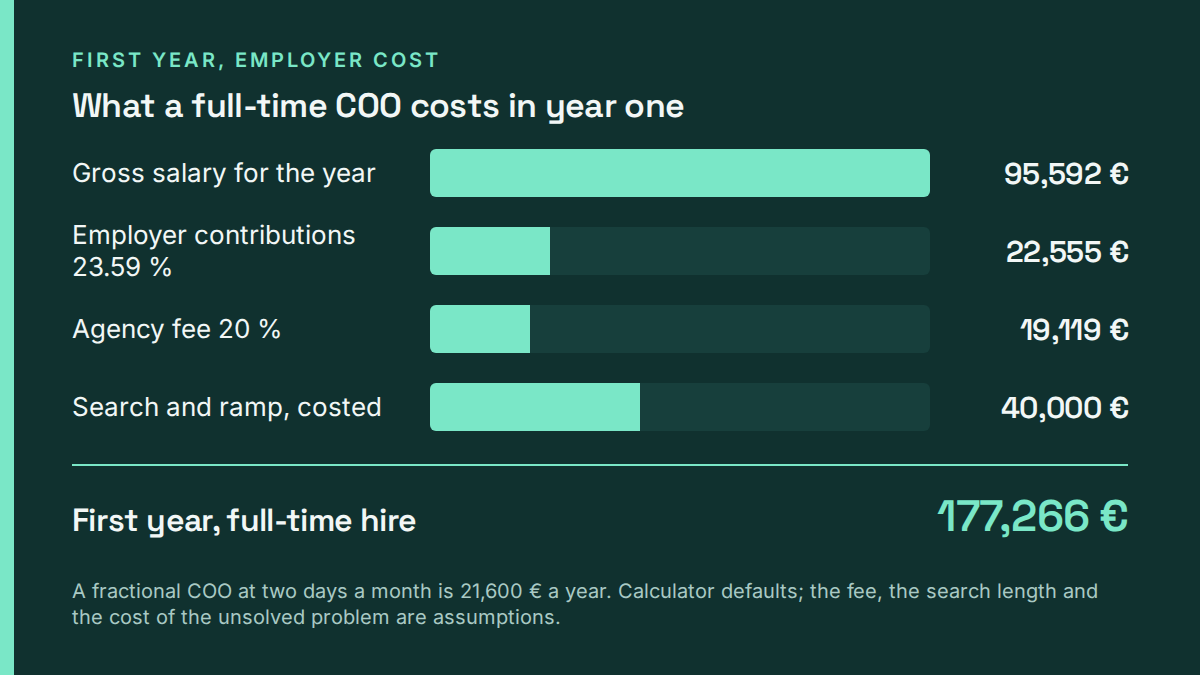
Take the default in our cost of hiring calculator: a net salary of EUR 5,452 a month, which grosses up to EUR 7,966. Employer social contributions run at 23.59 % on top, EUR 1,879 a month. That is EUR 9,846 a month in employer cost and EUR 118,147 a year, before anyone has been recruited.
Add a recruitment fee. At 20 % of first-year gross that is EUR 19,119, paid before the person starts. Add the months the seat sits empty and the months the new hire spends learning the business. Costed at EUR 5,000 a month for the problem that stays unsolved, that is another EUR 40,000. First year, all in: EUR 177,266.
Three of those numbers are assumptions, and it is worth naming which. There is no published Latvian benchmark for a recruitment fee, so the 20 % is a default you can change; international practice runs 15 to 25 %. The five months of search, the three months of ramp and the EUR 5,000 a month of unsolved problem are our assumptions too, not measured Latvian figures. The salary, the contribution rate and the arithmetic between them are not assumptions.
That cost buys something real: full ownership, full context, no split attention. It is the right model when the operations job is large enough and permanent enough to fill five days a week indefinitely, and when the company can carry both the cash and the wait. Below 150 people that is the exception rather than the rule.
Fractional COO: the same seniority, a defined number of days
A fractional COO is not a part-time employee and not a consultant who writes a report and leaves. It is an experienced operator in the seat for an agreed number of days a month, on a rolling engagement, doing the work a full-time COO would do: owning the operating rhythm, fixing the control problems, running the people who run the business. Our own model starts at EUR 1,800 a month for two days, EUR 21,600 a year, and scales with the number of days the company actually needs.
Three things make this fit most companies in the band. Cost, because the work genuinely does not fill five days. Speed, because an experienced operator starts in the first week rather than the ninth month. And reversibility, because the engagement is cancellable, so a bad fit costs a month of notice rather than severance and a second search.
The trade-off is real and worth saying plainly. A fractional COO is not in the building every day, and some decisions will wait for the next scheduled day. A company that needs someone physically on the floor every morning should pay for full-time.
Interim manager: a different job
An interim manager fills a specific seat for a specific period, usually because someone left suddenly, is on extended leave, or a transition is underway. The defining feature is not seniority or cost, it is the exit date. An interim engagement has one from the start, typically three to twelve months, and the mandate is to run what already exists rather than redesign it. Pricing sits close to a full-time equivalent, often at a premium, because it is full-time hours for a fixed term.
This is the model companies reach for by default, because “we need someone in that seat” is the most obvious way to describe the problem. It is the right call when the seat was working and the company needs continuity while it finds or grows a successor. It is the wrong call when the seat was not working before the departure either, because an interim manager will run the same broken operating rhythm competently for a year and hand it back unfixed.
The three models side by side
| Full-time COO | Fractional COO | Interim manager | |
|---|---|---|---|
| Employer cost | EUR 9,846 a month, EUR 118,147 a year | From EUR 1,800 a month, EUR 21,600 a year for two days | Close to full-time, often a premium |
| First year with fee and waiting | EUR 177,266 | EUR 21,600 | Full-term fee, no recruitment fee if placed directly |
| Time to start | Months to hire, then months to ramp | Days to weeks | Days to weeks |
| Commitment | Open-ended, full-time | Rolling, cancellable | Fixed term, usually 3 to 12 months |
| Mandate | Own and run, indefinitely | Own and run, part-time, ongoing | Hold and stabilise, then hand over |
| Weak fit | Company cannot carry the cost or the wait | Company needs someone present every day | The role was already broken before the departure |
How to decide, in three questions
Does the work fill five days a week, permanently? If yes, and the company can carry the cost and the wait, full-time is the honest answer. If the honest answer is “some weeks”, it is fractional.
Is this a gap to fill, or a job to redesign? A gap calls for interim. A job that has never really worked calls for fractional or full-time, because interim managers are chosen to hold steady, not to change the operating model.
Can the business survive a bad first fit? A full-time hire that does not work out costs severance, a second search and another year. A fractional engagement that does not work out costs a month of notice. For a company making this decision for the first time, that asymmetry is worth a great deal.
FAQ
Is a fractional COO the same as a consultant?
No. A consultant advises and leaves execution to the client. A fractional COO sits inside the operating rhythm, on a recurring schedule, doing the work a full-time COO does at a lower time commitment.
How many days a month does a fractional COO work?
Ours starts at two days a month and runs to eight. The right number depends on how much of the operations job is genuinely ongoing rather than project work.
Can a fractional engagement become a full-time hire later?
Yes, and often it should. Someone who has been inside the business for six months is the best-informed person to write the job description for their own full-time replacement.
What does an interim manager cost compared with a fractional COO?
Interim assignments are usually priced close to, or above, a full-time equivalent, because the interim manager commits full-time hours for a fixed period. Fractional pricing scales with days, which is why it is the lower-cost option for a role that was never full-time to begin with.
We are not sure which of the three we need. Where do we start?
Start with the scale-readiness scorecard: twelve questions, ten minutes, and a read on which control problems cost the most right now. If the answer points at process rather than people, the five signs your company needs an operations audit is the next thing to read.
Which daily job in your company currently has nobody answering for it?
Related: Recruiter fees in Latvia: what you pay and what you get.



 Latviešu
 English