
Direct answer. A company needs an operations audit when it is growing but the owner is working more, not less. Five signs show it most reliably: the same problem gets fixed again and again; decisions wait on one person; departments hold different numbers for the same thing; a new hire takes months to become useful; headcount grows faster than revenue. If you recognise two of the five, the problem is in the structure, not the people, and it will not fix itself.
Why do operational problems not announce themselves?
Because people are good. When a process does not work, the team learns to work around it: someone phones the warehouse instead of checking the system; the bookkeeper chases invoices herself because sales forgets; the owner checks orders in the evening because nobody owns on-time dispatch during the day. Each workaround is small on its own. Together they are the reason a 40-person company performs like a 25-person company with a 40-person payroll. An audit invents nothing. It shows exactly where work, cash and decisions stop, and what that costs per month.
Sign 1: the same problem keeps coming back
A customer complaint about delivery times. An invoicing error. An order stuck between sales and production. Each time it gets fixed, and each time it returns, usually with a different person at the wheel. If you can name three problems you have “solved” more than twice this year, you do not have three problems. You have one process with no owner. The first question in any audit is the same: who is responsible for this not happening again? If the answer is “everyone” or “me”, the answer is “nobody”.
Sign 2: decisions wait on one person
Usually the owner. A discount above five percent, a new supplier, a holiday approval, a complaint response, what may be promised to a customer. Each of these is a reasonable decision to keep. Together they mean the company moves as fast as the owner answers messages, and stops when the owner is away for two weeks. The sign is simple: if your calendar is the company’s bottleneck, you already know. An audit turns it into a list: which decisions, how often, and with what limits they can be handed over without risk.
Sign 3: departments hold different numbers
Sales says the month was good. Finance says the cash has not arrived. The warehouse says stock in the system does not match the shelf. All three are right, because each is looking at its own spreadsheet. In a company of 30-150 people this is the most common reason the Monday meeting runs two hours and ends without a decision: half the time goes on agreeing what actually happened. A number without one owner and one definition is not a number, it is a debate. An audit usually finds three to five of these, and the first fix is a single page with a name next to each one.
Sign 4: a new hire takes months to become useful
If onboarding means “sit next to Ieva and watch”, the company’s knowledge lives in people’s heads, not in processes. The cost shows up in two ways. First, ramp takes three to six months instead of three to six weeks, and during that time you pay a full salary for part of the work. Second, when Ieva leaves, the process leaves with her. In Latvia, where an experienced operations-level hire costs the employer around EUR 9,846 a month all-in, every month without full output is a concrete sum, not an abstraction.
Sign 5: headcount grows faster than revenue
The clearest sign, because it is a number. If revenue has grown 20 percent over two years and headcount 30 percent, the company is buying growth with people instead of with a system. That works until it does not, and it stops working in the first slow quarter, because salaries stay and revenue does not. The opposite case is just as dangerous: revenue up, headcount flat, team burning out. In both cases the audit starts with one ratio, revenue per employee by year, and asks why it is moving.
“In the first quarter of 2026 the average gross wage in the country was EUR 1,831, up EUR 73 or 4.2% on the first quarter of 2025.” (translated)
Central Statistical Bureau of Latvia, press release, 1 June 2026
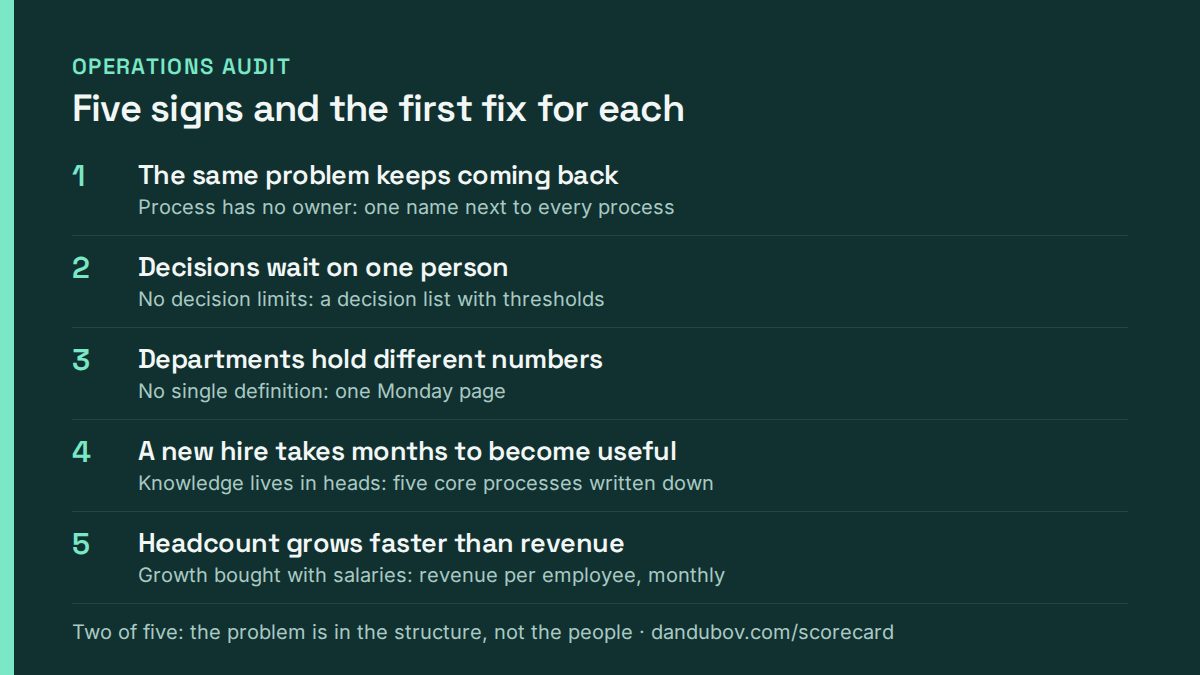
| Sign | What it usually means | First fix |
|---|---|---|
| Problem keeps returning | Process has no owner | One name next to every process |
| Decisions wait on one person | No decision limits | Decision list with thresholds |
| Different numbers | No single definition or source | One Monday page |
| Slow onboarding | Knowledge lives in heads | Five core processes written down |
| People grow faster than revenue | Growth bought with salaries | Revenue per employee, monthly |
What does an operations audit actually do?
Not write a report on how things should be, but trace how work actually moves: from order to cash in the bank, from vacancy to a person giving full output, from customer question to answer. In my practice this is two weeks of work. In week one I sit next to the people doing the work and watch where it stops. In week two the owner receives a written, prioritised plan: what to fix first, what it will deliver, who will own it. Not a hundred pages, but an ordered list you can start on Monday. The audit is short because the problems are usually visible by day three; the rest of the time goes on making sure every fix has an owner and a number.
How do you know whether you need one?
Two questions. First: how many of the five signs did you recognise, honestly? One is normal. Two means the structure no longer fits the size of the company. Three or more means you are already paying for it every month, the bill just does not arrive in one envelope. Second: what do another six months of meaning to deal with it cost? If the answer is above EUR 10,000 a month, which is common in a 40-person company, waiting is the expensive option.
Check for yourself. The Scale-Readiness Scorecard on this site asks 12 questions across these same five areas and shows your score immediately, no email required. Four minutes. If you score under 40, we should talk.
FAQ
How long does an operations audit take? Two weeks for a company of 30-150 people. A longer audit usually means a report is being written rather than a fix being found.
Does it disrupt daily work? Slightly. Week one needs 30-45 minute conversations with 8-12 people and access to the existing systems. Nobody stops working.
How is it different from a consultant’s report? A report describes how things should be. An audit shows how they are, where that costs money, and what to fix first, with a name next to every item.
What happens after the audit? Three options: the owner implements the plan alone; I help as an advisor two days a month; or I do it as a fractional operations executive eight days a month. All three are described on the home page.
Is it too early for a 15-person company? If the owner recognises three of the five signs, it is not too early. If one, the scorecard and a single conversation are enough.