

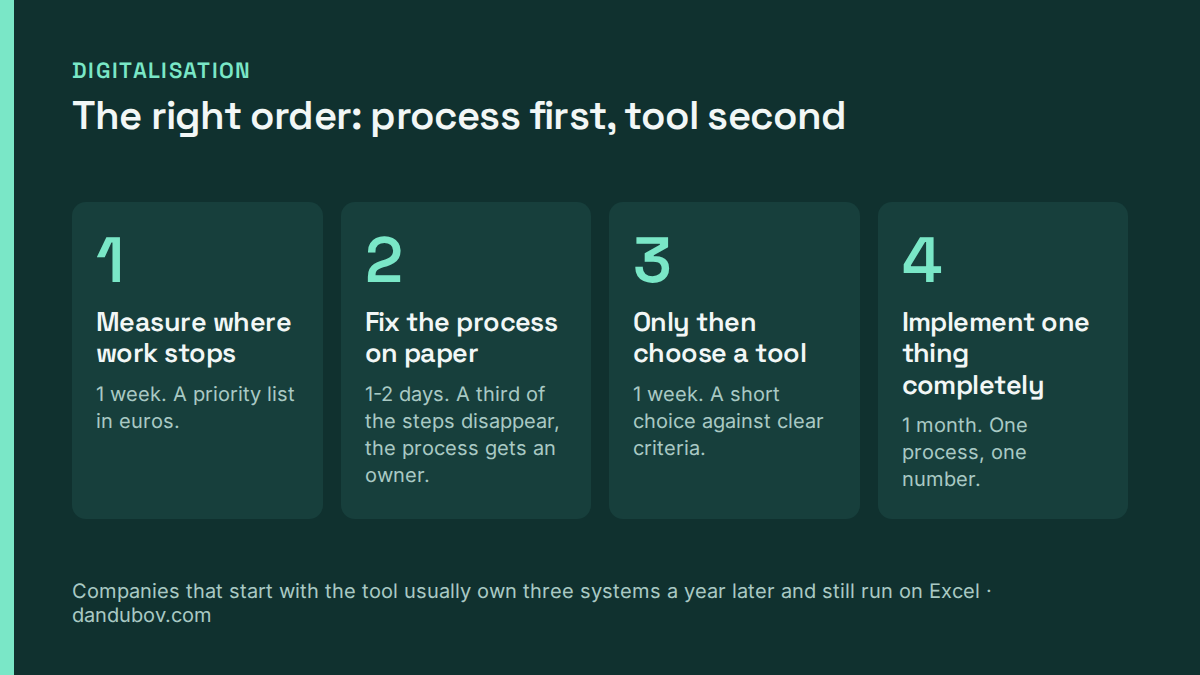
Direct answer. Digital transformation in a company of 30-150 people does not start with software. It starts with the one process that costs the most money or time today, and with the person who owns it. The right order is: measure where work stops; fix the process on paper; only then choose a tool; implement one thing completely before starting the next. Companies that start with the tool usually own three systems a year later and still run on Excel.
Why is “digital transformation” a bad place to start?
Because the term covers almost everything: a new accounting system, a CRM, an online shop, stock control, document workflow, AI in customer service. When everything is “transformation”, it is easy to start in the wrong place, usually wherever the salesperson was most convincing. The practical question is narrower: which process today takes the most people-hours for the least result? There are usually three candidates: the order’s path from customer to invoice, the hand-off between sales and delivery, and the reports someone assembles by hand every Monday. New software rarely fixes a broken process on its own; it makes it faster.
Step 1: measure where work stops
Before buying anything, keep a log for one week. How many times a day does someone retype data from one system into another? How long does an order wait between departments? How many hours a month go into preparing reports? In a 40-person company this week usually reveals 60-120 hours a month spent carrying data between spreadsheets. At the average all-in cost of an employee that is a concrete figure in euros, and it is your transformation budget and your priority list at the same time.
Step 2: fix the process on paper
Digitised chaos is faster chaos. If an order has four approvals today, two of which exist because someone made a mistake three years ago, the system will encode all four. Draw the process as it is, with every workaround. Then draw it as it should be: who does what, with which information, and what happens when something is missing. This step costs one or two days and usually removes a third of the steps before any software is involved. It is also the moment the process acquires an owner; without one, no system survives the first holiday.
Step 3: only then choose a tool
With the process drawn, choosing a tool becomes quick, because you know what it has to fit. Three rules that have saved Latvian SMEs the most money in practice. First: choose a tool the team can maintain without an external developer. Second: if the tool requires changing a process that works for you, choose a different tool. Third: start with the one integration that removes the most retyping, usually between sales and accounting. Whether it ends up being Pipedrive, HubSpot, Horizon, Odoo or a spreadsheet with a good form matters less than it seems; what matters is that everyone uses it and data is entered once.
Step 4: implement one thing completely
One process, one tool, one month, one number that shows whether it got better. After a month: did retyping hours fall? Does the order move faster? If yes, next process. If no, not the next tool, but the question why people are not using it, because the answer is almost always in the process or the owner, not the software. This rhythm, one process a month, digitises ten processes in a year. That is more than most “transformation projects” achieve in three.
| Order | What it gives you | How long |
|---|---|---|
| 1. Measure where work stops | A priority list in euros | 1 week |
| 2. Fix the process on paper | A third of the steps disappear, the process has an owner | 1-2 days |
| 3. Choose a tool | A short choice against clear criteria | 1 week |
| 4. Implement completely | One process, one number | 1 month |
Is there funding for this?
Yes, though not always at the moment you need it. In Latvia, business digitalisation is co-funded by the state and the EU, and the support comes in rounds. The largest recent programme, LIAA’s “Support for process digitalisation” under the Recovery Fund with grants of up to EUR 100,000, closed to new applications in 2025; new rounds are announced on the LIAA site and on business.gov.lv. Available continuously is the Latvian Digital Innovation Centre (EDIH), where a digital maturity assessment and expert consultations cost from a few hundred euros, part of it covered by EU funding. Two things worth knowing before applying. First, applications are most often rejected because the project describes a tool rather than a measurable process improvement; steps 1 and 2 above are exactly what the assessors want to see. Second, grants reimburse part of the cost afterwards, so cash flow has to be planned for the full amount. I have run a LIAA co-funded digitalisation project from application to final report; a separate article will cover which programme fits which company and the typical mistakes.
“Within this funding the Investment and Development Agency of Latvia is expected to provide grant support to at least 1,750 companies for the digitalisation of internal business processes.” (translated)
LIAA, “Over EUR 27 million available to companies for process digitalisation”, 27 November 2024
How do you know where to start in your company?
Three questions. Which process takes the most manual work today? Which number in the company is “approximate” because nobody trusts it? Which person would leave, and take with them the way half the work gets done? The answer to any of these is your first project. If there is no answer, it usually means nobody specific owns day-to-day operations, and that is a sign you need an operations audit first, not software.
Check for yourself. The Scale-Readiness Scorecard shows in 12 questions how ready your processes already are for digitalisation, and which of five areas to start with. Four minutes, no email required.
FAQ
What does digital transformation cost a small company? The first process usually costs under EUR 5,000 including the tool and implementation, if done in the order above. The largest cost is people’s time, not licences.
CRM or accounting system first? Whichever removes more manual work. In companies with active B2B sales it is almost always a CRM connected to invoicing.
Is AI a good place to start? Rarely. AI speeds up a process that already works; for a broken process it produces faster mistakes. Start with step 1.
How long does it all take? First process: six to eight weeks from measuring to a working result. After that, one process a month.
What is the biggest mistake? Starting with the tool a salesperson showed in a demo and bending the company to fit it. The second biggest: implementing three things at once.