


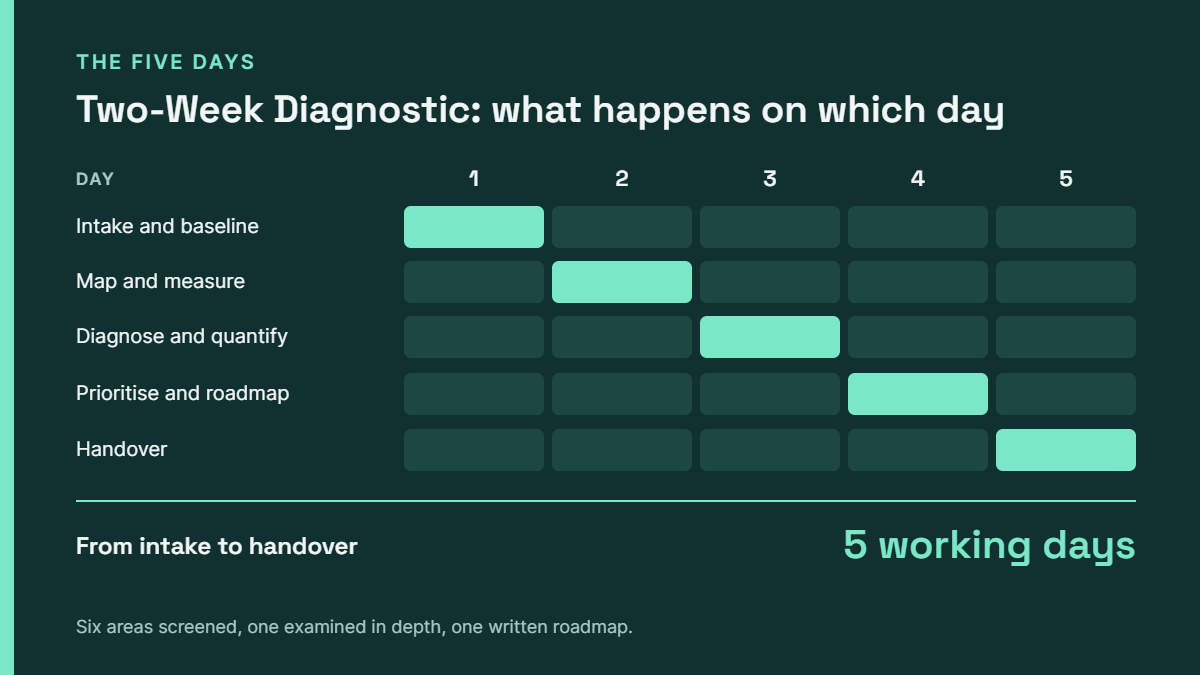
When something in an owner-managed company is stuck, the hard part is saying where. The Two-Week Diagnostic exists to answer that question with five days of work spread over about two calendar weeks, for a fixed price, with a written roadmap at the end. If you are still deciding whether anything is stuck at all, the five signs that a company needs an operations audit are a quicker first check.
Who it is for
Owner-managed Baltic companies with roughly 10 to 60 employees and EUR 0.5M to 15M in revenue.
What is looked at
Six areas are screened: strategy and business model, demand and the commercial engine, delivery and fulfilment, supply and working capital, people and accountability, and systems and data. One of them goes deep. You choose which one with me on Day 1, using three tests: how important the area is to the strategy, how healthy it is today, and how realistic it is to improve.
The five days
- Day 1, intake and baseline. We agree the problem statement and the one deep area, and sign them. Day 2 does not start without that signature.
- Day 2, map and measure. I map how the work really happens, workarounds included, not the documented version. If data is missing, that is written down as a finding.
- Day 3, diagnose and quantify. You see an interim readout. Every finding is previewed with you before it goes in the report.
- Day 4, prioritise and roadmap. Findings are ranked by the size of the prize, the effort, and whether they relieve the one constraint that limits the business. I then try to break my own conclusions before you see the roadmap.
- Day 5, handover. You leave with a named day for the first action.
The idea behind it
When a control fails, the cause is one of three things. People do not know what is expected (direction), they know but are not motivated, usually because their own incentive points elsewhere (motivation), or they know and want to but lack the tool, time, skill or information (capability). The fix differs sharply for each. More process is only right for the first. The answer comes from asking the person doing the work.
What you get
A written report with the evidence behind every finding: what people said, what your own data shows, and an outside comparator. A scored view of where you stand across the areas. A prioritised roadmap. The method then continues with follow-through at 30, 60 and 90 days, when the main constraint is scored again to see whether it has moved.
Terms
Fixed price, half on acceptance and half on delivery. The diagnostic is built to lead to an execution engagement, and I say so up front rather than letting you discover it later.
Related: What a COO actually does in a 50-person company, and what they do not. First check: Scale-Readiness Scorecard.




 Latviešu
 English