

Direct answer. Hiring a CEO-level operations executive in Latvia costs an employer about EUR 9,846 a month, or EUR 118,147 a year, before recruitment fees of EUR 14,300-23,900 and a typical four to six month search. An experienced operator on a defined-days retainer does the load-bearing part of the same job for EUR 1,800-7,500 a month, from the first week, with no recruitment cost and no severance exposure.
Why does the salary number understate the cost?
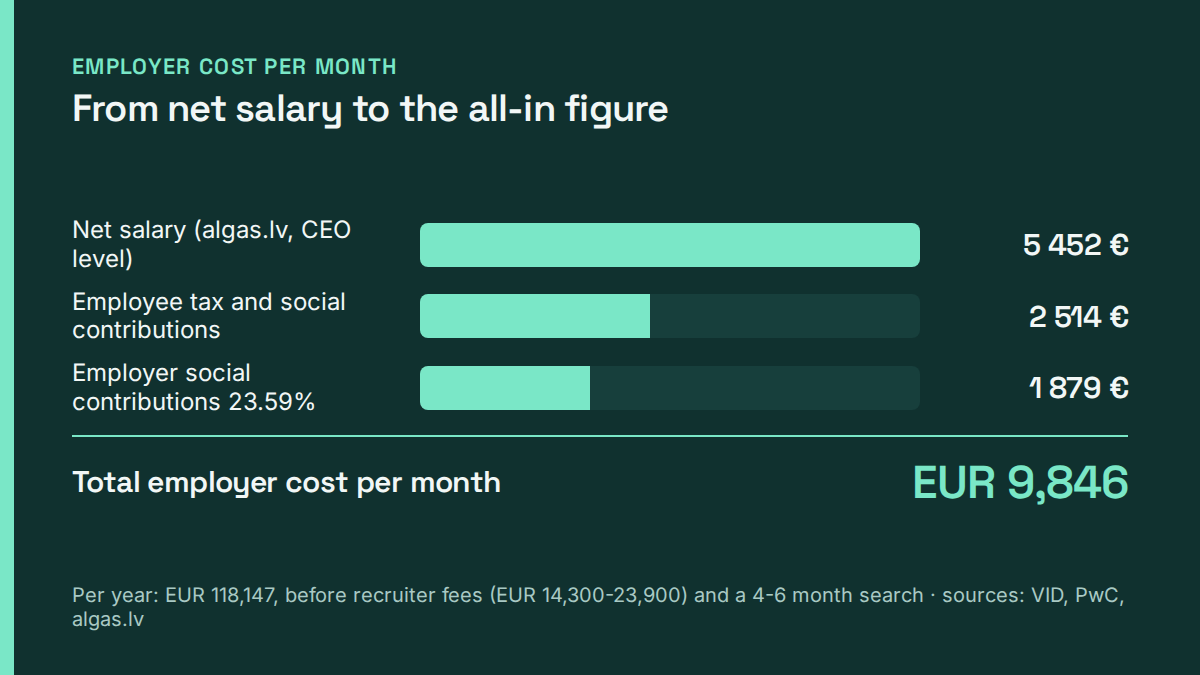
Owners usually think about the hire in net salary terms, because that is the number the candidate negotiates. The employer pays something quite different. Starting from the algas.lv survey average for a CEO-level role, a net salary of EUR 5,452 a month grosses up to EUR 7,966 once employee social contributions (10.50%) and personal income tax (25.5% in 2026 on income up to EUR 105,300) are added back. The employer then pays social contributions of 23.59% on top of gross, another EUR 1,879. The monthly cost to the company is EUR 9,846. Over a year that is EUR 118,147, and Latvian wage growth of 7.6-8.0% against GDP growth of 2-3% means the same role costs roughly EUR 127,000 next year (PwC Worldwide Tax Summaries, Latvia; Balansis employer guide 2026).
| Line | Monthly | Annual |
|---|---|---|
| Net salary (algas.lv survey average, CEO level) | EUR 5,452 | EUR 65,427 |
| Employee tax and social contributions (borne by the employee) | EUR 2,514 | EUR 30,169 |
| Gross salary | EUR 7,966 | EUR 95,596 |
| Employer social contributions, 23.59% | EUR 1,879 | EUR 22,551 |
| Total employer cost | EUR 9,846 | EUR 118,147 |
| Recruitment fee, 15-25% of first-year gross | EUR 14,300-23,900 | |
| Ramp, holiday cover, severance exposure, wrong-hire risk | not quantified, large |
What does the search itself cost?
Two things the salary table does not show. First, the recruiter: executive search in the Baltics typically charges 15-25% of first-year gross, so EUR 14,300-23,900 for this role, invoiced whether or not the hire works out. Second, time: four to six months from deciding to hire to a start date is normal for a senior operations role in a market of 1.85 million people, and a further two to three months of ramp is normal before the new executive changes anything. The company lives with the original problem for most of a year. If the problem is margin leakage, late cash, or a sales pipeline that depends on the founder, that year has a price of its own.
When is the hire the right answer?
Often. If the company has passed roughly 80-100 people, has a stable operating rhythm that needs running rather than building, and can absorb a nine-month lead time, a permanent executive is the correct structure and a retainer would be the wrong one. The hire is also right when the role is mostly people leadership rather than system building, because presence matters more than experience there.
When is it the wrong answer?
When the job is to build the operating system rather than run it. Companies of 15-80 people usually do not need a full-time executive; they need someone who has built reporting, process ownership, cash discipline and a sales machine before, to do it again, quickly, and then hand it over. That is a defined piece of work with a beginning and an end, and paying EUR 118,000 a year plus a recruiter for a permanent seat to do temporary work is the expensive way to buy it.
What does the alternative cost?
An operator on a retainer, with a defined number of days a month. In my practice the models are: an ongoing advisor at two days a month from EUR 1,800, on a three-month minimum; a fractional executive at eight days a month, on a six-month minimum, at roughly half the cost of the hire; and, as the way in, a Two-Week Diagnostic at a fixed price that maps how work actually moves through the company and delivers a written, prioritised plan. All three start within weeks, not months. None carries a recruitment fee, a notice period beyond the minimum term, or severance. The person on the first call is the person doing the work.
| Option | Monthly cost | Time to first fix | Exit cost |
|---|---|---|---|
| Permanent operations executive | EUR 9,846 plus EUR 14,300-23,900 once | 6-9 months | Severance, re-search |
| Fractional executive, 8 days a month | about half the hire | Week 2-3 | End of 6-month term |
| Ongoing advisor, 2 days a month | from EUR 1,800 | Week 2-3 | End of 3-month term |
| Two-Week Diagnostic | fixed price, once | Day 14: written plan | None |
How do you decide?
Three questions. Is the work building or running? Building favours the operator, running favours the hire. Can the company wait nine months? If the problem is costing more than EUR 10,000 a month now, it cannot. Is the company past the point where one experienced person can fix the structure in a defined engagement? If yes, hire, and consider using the operator to run the search and the handover.
Run your own numbers. The calculator on this site takes your target net salary, recruiter percentage and expected search time and shows the all-in cost next to the three engagement models. No email needed for the result.
FAQ
How much does a COO earn in Latvia in 2026? Surveyed CEO-level net salaries average around EUR 5,452 a month (algas.lv); operations director roles at 50-250 person companies typically fall in a net range of EUR 3,500-6,500 depending on sector, which is EUR 6,300-11,800 a month all-in to the employer.
What is the employer social contribution rate in Latvia? 23.59% of gross salary in 2026, with the employee paying a further 10.50% (PwC Latvia tax summary).
What is a fractional executive? An experienced operator who works inside a company for a fixed number of days a month, with executive-level ownership of a defined area, for a defined term. Not a consultant who writes a report and leaves, and not an interim who fills a vacant seat full time.
How long does it take to hire a senior operations executive in Latvia? Four to six months to a start date is typical, plus two to three months of ramp.
Does a retainer replace a COO permanently? Usually not. The common pattern is a six to twelve month fractional engagement that builds the operating system, then a permanent hire into a role that now has a defined job, working processes and a reporting rhythm.
Weighing a permanent hire against the alternatives? The three models compared, with what each one costs: fractional COO vs full-time COO vs interim manager.